National Preparedness Month: Preparing Together for the Unexpected
The ability to respond effectively when an emergency strikes depends on the planning and partnerships that happen long before a crisis begins. Preparedness takes place at every level, from households preparing for severe weather to healthcare organizations participating in large-scale emergency exercises.
Every September, National Preparedness Month highlights the steps individuals, families, organizations and communities can take to prepare for emergencies. This year’s theme, “America Stands Ready,” emphasizes the importance of taking action before an emergency occurs.
Since 2003, WellLink Health Alliance’s emergency preparedness program has helped coordinate regional healthcare preparedness, serving as the healthcare coalition coordinator for 25 acute care hospitals across a five-county region. With support from the Hospital Preparedness Program through the Administration for Strategic Preparedness and Response (ASPR) and the Ohio Department of Health, the program helps hospitals strengthen their ability to respond when emergencies affect the healthcare system.
Two exercises in August demonstrated what that preparedness looks like in practice. One tested the complex coordination required to receive patients evacuated during a large-scale disaster. The other brought agencies together along Cleveland’s lakefront to practice responding to an emergency requiring both land and water rescue.
Coordinating Patient Care During a National Disaster Medical System Exercise
On August 11, WellLink Health Alliance Emergency Preparedness Program Manager Christina Fozio and Training & Exercise Coordinator Derek Duty supported a National Disaster Medical System (NDMS) exercise at Cleveland Hopkins International Airport, where the exercise was held for the first time.
The scenario involved a natural disaster affecting an East Coast hospital that needed to evacuate patients to safer locations. The exercise brought together healthcare workers, emergency management, public safety and community partners to practice receiving those patients and coordinating their movement into the healthcare system.
In an actual NDMS response, patients may be transported aboard military aircraft to designated Federal Coordinating Centers, including Cleveland. Although a military aircraft was not available for the exercise, participants practiced the other hands-on components of a response, including patient triage, tracking, transportation and coordination with receiving hospitals.
Federal, state and local partners participated, including the Department of Veterans Affairs, ASPR, the U.S. Department of Health and Human Services, Cuyahoga County Emergency Management Agency, Cuyahoga Emergency Communications Systems, fire and emergency medical services (EMS) agencies and volunteer response organizations.
For WellLink, the exercise tested a critical piece of the regional response: connecting incoming patients with hospitals that have the capacity to receive them and maintaining visibility into where those patients go.
Following an alert, WellLink’s emergency preparedness team would work with key stakeholders to gather information about hospital bed availability and identify facilities willing and able to accept incoming patients. As patients are triaged, the team would coordinate with county emergency management, hospitals, dispatchers and EMS providers to determine where patients should be transported.
Multiple patient-tracking and communication systems help partners maintain visibility throughout that process, from arrival and triage through transportation and admission to a receiving hospital. Accurate tracking also supports family reunification by helping responders determine where individual patients have been transported.
The exercise allowed healthcare and emergency response partners to test those processes together before they are needed during an actual disaster.
Preparing for an Emergency Along the Lakefront
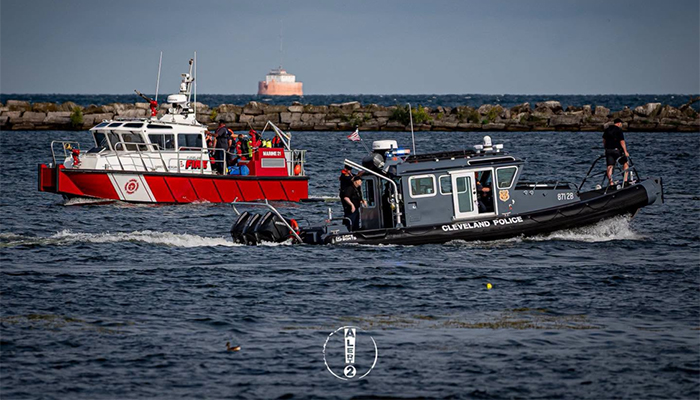
Just over a week later, on August 19, WellLink’s Derek Duty participated in a multi-agency emergency response exercise at Cleveland’s Burke Lakefront Airport.
The scenario involved an aircraft coming up short of the runway and crashing into Lake Erie, requiring emergency crews to respond from both land and water. Local, county, state and federal agencies participated, including the U.S. Coast Guard, Ohio Department of Natural Resources, Cleveland Police, Cleveland Fire and EMS, Cuyahoga County Emergency Management Agency and specialized water rescue teams.
A major focus was coordination among agencies that may not regularly work together. Participants practiced communicating across jurisdictions and tested how water rescue crews, land-based responders, equipment and personnel could move through the response.
Exercises like this also provide an opportunity to identify gaps before an actual emergency. For WellLink, participation means supporting community partners, strengthening relationships and looking for opportunities to connect the healthcare preparedness network with the broader emergency response system.
The exercise led to conversations with Cleveland EMS commanders about ways WellLink could support EMS during large, planned events. Discussions with Cuyahoga County Emergency Management Agency also explored emergency response volunteers and opportunities to strengthen volunteer support throughout the county.
Those conversations illustrate one of the less visible benefits of emergency exercises. The relationships built and lessons learned during a planned event can make communication and collaboration easier when the stakes are real.
WellLink’s preparedness work continues throughout the year. The team is currently planning the 2027 Medical Response and Surge Exercise (MRSE), an annual Hospital Preparedness Program exercise designed to evaluate the ability of healthcare coalitions and other stakeholders to support medical surge.
Preparedness Starts at Home
The same principle applies to individual preparedness: the best time to plan for an emergency is before one happens.
The Federal Emergency Management Agency’s (FEMA) Ready Campaign encourages American resourcefulness by sharing simple, affordable steps to stand ready:
- Make a plan for your household, including your pets, so that you and your family know what to do, where to go and what you will need to protect yourselves during a disaster.
- Sign up for your community’s warning system. The Emergency Alert System and National Oceanic and Atmospheric Administration Weather Radio also provide emergency alerts.
- Build a kit. You may think building a well-stocked emergency kit is difficult or expensive, but it doesn’t need to be. You can gather supplies over time, starting with items you may already have at home like canned food and first aid supplies. Visit ready.gov/kit for a list of items to include and how to tailor your kit to meet your family’s needs.
Preparedness also includes thinking about the safety of your home during an emergency. Wildfire smoke, flooding, extreme temperatures and power outages can create indoor air quality risks. The U.S. Environmental Protection Agency offers guidance on steps households can take, including creating a cleaner-air room during wildfire smoke events, maintaining working carbon monoxide alarms and safely managing ventilation and backup power during outages. Learn more about emergencies and indoor air quality from the EPA.
Individual preparedness can strengthen the wider community, too. Getting to know neighbors, learning basic first aid or CPR, staying informed about local emergency plans and checking on people who may need additional assistance can all help build community resilience.
For Northeast Ohio residents, ReadyNotify provides emergency notifications by text message, phone call and email. Residents can also sign up for the CodeRED mobile alert app.
The exercises supported by WellLink are part of an ongoing effort involving healthcare organizations, government agencies, first responders and community partners across the region. They provide opportunities to test systems, strengthen relationships and work through challenges before those connections are needed during an actual emergency.
National Preparedness Month is a reminder that everyone has a role to play. For individuals, that may mean updating an emergency plan or supply kit. For WellLink and its partners, it means continuing to build the relationships and systems that help protect patients, families and communities when emergencies occur.